
Avenity Business Solutions · AI Visibility for Churches
Every week, families in your city search “churches near me” — and Google’s AI recommends a short list of names. If your church isn’t on it, they never knew you existed. We change that.
Get your free AI Church Visibility AuditSee how it Works
New Church Plants
Established Churches
Multi-Site Networks
The Real Problem
If These Questions Sound Familiar, Your Church Has an AI Visibility Problem
Most church leaders don’t realize Google’s AI is making recommendations before anyone clicks a single link. The families you’re called to reach may never find you — not because your church isn’t ready, but because Google doesn’t know you exist.
New Church Plants
We just launched — how do we get found before we have years of history behind us?
A new church plant built on the right digital foundation can establish AI search visibility in weeks, not years. The architecture matters more than the age. Families searching for churches in your city don’t know you launched last month — they just want Google to give them the right answer.
Established Churches
We’ve been serving this community for 15 years. Why are newer churches showing up in Google and we’re not?
Longevity doesn’t automatically translate into AI visibility. Google’s AI looks for clarity of identity — your denomination, worship style, location, and who you serve — declared consistently across every platform it reads. An established church with a vague or outdated website can be invisible while a new church with the right structure ranks first.
Discovery
When someone in our city Googles “contemporary church near me” — do we even show up?
Probably not — and you can verify it right now. Open Google and search for the style of church you are in your city. If your church isn’t named in the AI Overview at the top of the results, Google’s AI isn’t recommending you. The families who would love your church are being sent somewhere else.
Growth
We rely on word of mouth and social media. Is AI search really that important?
Word of mouth and social media reach people who already know you. AI search captures the families actively looking — people who just moved to your city, new parents seeking a church family, people returning to faith. These are your highest-intent visitors, and right now Google is directing them somewhere else.
Church Plants
We don’t have budget for a big marketing agency. Is AI visibility realistic for a new plant?
Yes — and it’s actually easier to build correctly from the start than to retrofit an established church’s outdated digital presence. Avenity works with church plants at a price point designed for ministry budgets. The ADORA case study shows what’s possible when the foundation is built right from day one — even with zero prior online presence.
Both
Our website looks fine. Why would we need to change anything?
Looking good and being found by AI are two different things. Most church websites were designed for human visitors and traditional search. Google’s AI reads websites differently — it’s looking for structured entity signals, consistent information across platforms, and content that clearly answers the questions families ask before they ever set foot in a church.
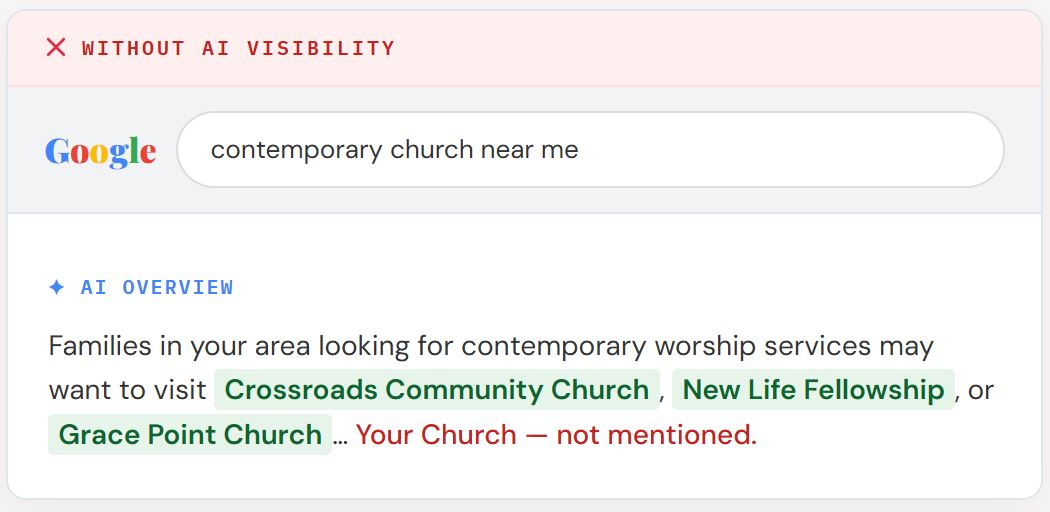
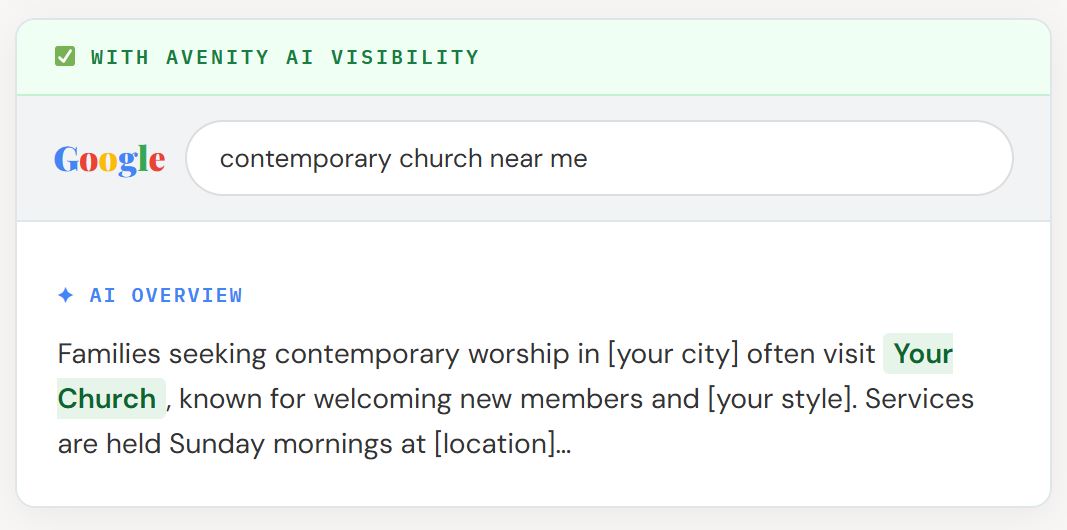
What Families Actually See
This Is the Moment Your Church Either Gets Found — or Doesn’t
Before a family clicks anything, Google’s AI generates a recommendation. The churches named in that recommendation get the visit. The churches not named never appear in the conversation.
Two Different Starting Points. One Framework.
We Work With Churches at Every Stage
Whether you’re launching your first Sunday or you’ve been in your community for decades, the AI visibility gap looks different — and so does the path to closing it.
New Church Plants
Launching right · Building from day one
A church plant has one rare advantage: no legacy structure to undo. When we build your digital foundation AI-native from the start, Google’s trust-building timeline compresses dramatically. You don’t need years of history to show up first — you need the right foundation.
- AI-native website build structured for Google’s entity recognition from launch day
- Google Business Profile configured to appear in “churches near me” searches immediately
- Entity signals declared consistently across every platform Google reads at launch
- Foundation built to earn a Google Knowledge Panel faster than established competitors
- AI Overview targeting for your denomination, worship style, and city from day one
Established Churches
Unlocking hidden authority · Closing the visibility gap
An established church has something a new plant doesn’t: real community presence, years of service, and genuine authority. The problem is Google’s AI often can’t see it — because that authority was never structured in a way AI can read and trust. We fix that without disrupting what’s working.
- AI visibility audit showing exactly what Google recommends when families search for you
- Entity signal cleanup — consistent identity across your site, GBP, and all platforms
- Worship style and service landing pages structured for AI search intent
- Review strategy to build the signals Google’s AI needs to trust your church
- FAQ schema that surfaces your church in the specific questions families are asking
Why Now
The Way Families Find Churches Has Changed — Permanently
AI-powered search isn’t a trend. It’s the new front door for every family that’s new to your city, returning to faith, or looking for something different. The churches that build their AI visibility now will hold those positions for years.
6 in 10
Americans use online search to find a new church when relocating
AI First
Google’s AI Overview appears before any organic results — it’s the first thing families see
Most
Texas church websites were built before AI search existed — and haven’t been updated since
”“Anyone can eventually get a church website to rank on Google. But Google only builds a Knowledge Panel — and names a church in its AI Overviews — when it trusts that church as a real, verified community anchor. That trust is built deliberately, not accidentally.”
— Daniel Katen · Avenity Business Solutions
The Framework
The AI Visibility Authority Engine™ — Applied to Churches
The same three-pillar framework that got a brand-new security company to #1 on Google in 45 days works for churches — because the underlying principle is the same. Google’s AI recommends what it can identify, trust, and categorize. We build all three.
01 — Clarity
Google knows exactly who you are
Your denomination, worship style, service times, location, and who you serve must be declared clearly and consistently — not buried in vague language or scattered across outdated pages. AI can’t recommend what it can’t confidently identify.
Church example: “Non-denominational contemporary church serving young families in Conroe, TX — Sunday 9AM & 11AM” declared identically across your website, Google Business Profile, and every citation site Google reads.
02 — Authority
Google trusts you enough to recommend you
Reviews, citations, a Google Knowledge Panel, and consistent community signals tell Google’s AI that your church is a real, trusted anchor in your community. Without these, even a beautifully designed website remains invisible in AI search.
Church example: Google Knowledge Panel established, Google reviews building steadily, church listed in community directories, local news mentions or event coverage all contributing to entity trust.
03 — Structure
Your website speaks Google’s AI language
Most church websites were built for human visitors in the pre-AI era. Google’s AI reads content differently — it’s looking for structured, parseable information that directly answers the questions families ask before they visit. We build that structure.
Church example: Service pages built around search intent (“contemporary worship Conroe TX”), FAQ schema answering “what to expect at your first visit,” and content structured so AI can extract and cite your church as the answer.
Common Questions
Frequently Asked Questions
Questions we hear from church leaders and church planters before they start.
Why isn’t our church showing up when people search “churches near me”?
Most church websites were built to look good, not to be understood by Google’s AI. Google’s AI Overviews recommend churches based on entity clarity — how clearly your church’s identity, denomination, worship style, and location are declared across every platform Google reads. If that information is inconsistent, incomplete, or buried in vague language, Google’s AI won’t recommend you — even after years of ministry.
Can a brand new church plant show up in Google search results quickly?
Yes. A new church plant built on an AI-native digital foundation can establish search visibility significantly faster than an established church running on an outdated website structure. When the AI Visibility Authority Engine framework is applied from day one, Google’s trust-building timeline compresses from 12+ months to weeks. The ADORA Private Security case study proves this is possible — a brand new organization reaching #1 on Google in 45 days with zero prior online presence.
Does our church need to rebuild its website to get AI visibility?
Not necessarily. In many cases we build AI-optimized landing pages alongside your existing site — no redesign required. The priority is ensuring your church’s identity signals are clear and consistent across all the platforms Google reads. Often the gap is in structure and entity signals, not in the website design itself.
What does this cost — and is it realistic for a church budget?
Avenity structures its church services at a price point designed for ministry budgets. We start with a free AI Visibility Audit so you can see exactly where your church stands before any conversation about investment. There’s no obligation in the audit — just a clear, honest picture of what Google’s AI is currently recommending when families search for a church in your city.
We already do social media and run ads. Is AI visibility really different?
Completely different — and complementary. Social media reaches people who already know you. Ads capture people at the bottom of the funnel. AI visibility captures the families in the middle — actively searching, open to something new, ready to visit — who aren’t clicking ads and haven’t heard of you yet. These are your highest-intent prospects and right now Google is directing them to churches that built their AI visibility first.
Find Out If Your Church
Shows Up When Families Search.
We’ll search the queries families in your city are actually using — and show you exactly what Google recommends. No obligation. 20 minutes.
Book a Free Church AI Visibility Audit
Daniel Katen · Avenity Business Solutions
936-701-0994 · avenitybusinesssolutions.com · Montgomery, TX